Sunshine State Standards Covered by Reading Comprehension and DBQ
Social Studies:
SS.912.A.2.5 – Assess how Jim Crow Laws influenced life for African Americans and other
racial/ethnic minority groups.
SS.912.A.3.12 – Compare how different nongovernmental organizations and progressives
worked to shape public policy, restore economic opportunities, and correct
injustices in American life.
SS.912.A.4.11 – Examine key events and peoples in Florida history as they relate to United
States history.
SS.912.A.7.2 – Compare the relative prosperity between different ethnic groups and social
classes in the post-World War II period.
SS.912.A.7.5 – Compare nonviolent and violent approaches utilized by groups (African
Americans, women, Native Americans, Hispanics) to achieve civil rights.
SS.912.A.5.10 – Analyze support for and resistance to civil rights for women, African
Americans, Native Americans, and other minorities.
SS.912.A.7.6 – Assess key figures and organizations in shaping the Civil Rights Movement and
Black Power Movement.
SS.912.A.7.7 – Assess the building of coalitions between African Americans, whites, and other
groups in achieving integration and equal rights.
SS.912.A.7.12 – Analyze political, economic, and social concerns that emerged at the end of the
20th century and into the 21st century.
SS.912.C.2.9 – Identify the expansion of civil rights and liberties by examining the principles
contained in primary documents.
SS.912.S.1.6 – Distinguish fact from opinion in data sources to analyze various points of view
about a social issue.
SS.912.S.5.6 – Identify the factors that influence change in social norms over time.
SS.912.S.6.3 – Describe how collective behavior can influence and change society.
Language Arts:
LAFS.910.RI.1.1 – Cite strong and thorough textual evidence to support analysis of what the text
says explicitly as well as inferences drawn from the text.
LAFS.1112.RI.1.3 – Analyze a complex set of ideas or sequence of events and explain how
specific individuals, ideas, or events interact and develop over the course of the
text.
LAFS.1112.RI.3.7 – Integrate and evaluate multiple sources of information presented in different
media or formats (e.g., visually, quantitatively) as well as in words in order to
address a question or solve a problem.
LAFS.910.RI.2.4 – Determine the meaning of words and phrases as they are used in a text,
including figurative, connotative, and technical meanings; analyze the cumulative
impact of specific word choices on meaning and tone (e.g., how the language of a
court opinion differs from that of a newspaper).
LAFS.910.RI.3.7 – Analyze various accounts of a subject told in different mediums (e.g., a
person’s life story in both print and multimedia), determining which details are
emphasized in each account.
LAFS.910.RH.1.2 – Determine the central ideas or information of a primary or secondary source;
provide an accurate summary of how key events or ideas develop over the course
of the text.
LAFS.910.RH.1.3 – Analyze in detail a series of events described in a text; determine whether
earlier events caused later ones or simply preceded them.
LAFS.1112.RH.3.7 – Integrate and evaluate multiple sources of information presented in diverse
formats and media (e.g., visually, quantitatively, as well as in words) in order to
address a question or solve a problem.
LAFS.1112.RH.3.9 – Integrate information from diverse sources, both primary and secondary,
into a coherent understanding of an idea or event, noting discrepancies among
sources.
LAFS.910.WHST.3.8 – Gather relevant information from multiple authoritative print and digital
sources, using advanced searches effectively; assess the usefulness of each source
in answering the research question; integrate information into the text selectively
to maintain the flow of ideas, avoiding plagiarism and following a standard
format for citation.
LAFS.910.WHST.3.9 – Draw evidence from informational texts to support analysis, reflection,
and research.
UCLA History Standards:
Civil War and Reconstruction: Standard 3B – The student understands the Reconstruction
programs to transform social relations in the South.
Evaluate the goals and accomplishments of the Freedmen’s Bureau. [Hold
interpretations of history as tentative]
Describe the ways in which African Americans laid foundations for modern black
communities during Reconstruction. [Hypothesize the influence of the past]
Historical Thinking Standard 3 – The student engages in historical analysis and interpretation.
We would love to hear from you! Click the Get In Touch button or stop by! The Jones High School Historical Museum is located on the campus of 801 S. Rio Grande Avenue, Orlando, Florida 32805. The Historical Museum is housed in the Media Building near the Library.
Jones High School Historical Society, Inc. is a 501(c)(3) public charity as determined by Internal Revenue Code Section 509(a)(2). Donor contributions are tax deductible as specified in Internal Revenue Code Section 170.
Jones High School Historical Society, Inc. is authorized under Chapter 496, Florida Statutes, to solicit contributions as determined by Florida Department of Agriculture and Consumer Services.
“A COPY OF THE OFFICIAL REGISTRATION (#CH82276) AND FINANCIAL INFORMATION MAY BE OBTAINED FROM THE DIVISION OF CONSUMER SERVICES BY CALLING TOLL-FREE (800-435-7352) WITHIN THE STATE. REGISTRATION DOES NOT IMPLY ENDORSEMENT, APPROVAL, OR RECOMMENDATION BY THE STATE.”
Funding for this digital exhibit was provided through a grant from the Florida Humanities Council with funds from the National Endowment for the Humanities. Any views, findings, conclusions or recommendations expressed in this exhibition website do not necessarily represent those of the Florida Humanities Council or the National Endowment for the Humanities.

Support our cause and make a difference with your generous donation!
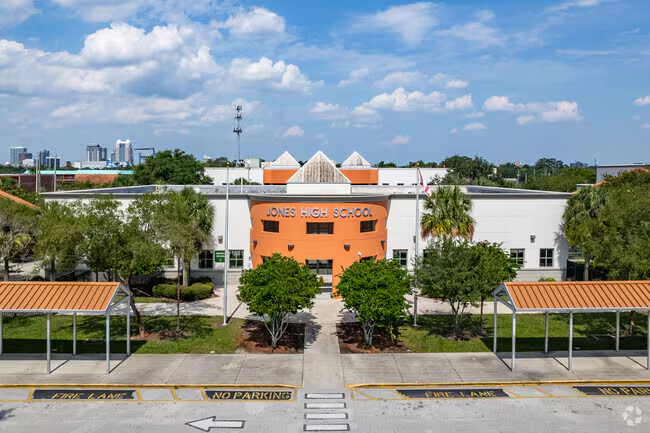
Jones High School Historical Museum
is located on the campus of
801 S. Rio Grande Avenue
Orlando, Florida 32805.
The Museum is currently open on Monday and Tuesday from 9:00am to 12:00pm during the regular school session.