Questions 1-7 refer to the following text:
Mayor Bob Carr, Dr. King, and a delegation from the black community met that
afternoon at City Hall. Perry describes the meeting as having “very tuff [sic] and frank
talk of [the] condition(s) in Orlando. Rev. King made [it] clear that he would come back
if things did not change in Orlando. Mayor Bob Carr ask[ed] Rev. King to give him time,
that he would put together a Bi-Racial Committee to solve problems and end segregation
in the city.” Shortly after this visit, Mayor Carr did form a bi-racial committee and began
tackling some of the community’s problems.
After meeting with the mayor, Dr. King returned to Shiloh Baptist Church for the second
workshop session and met with youth leaders including Jim Perry. It was at this time that
Perry “was Bless[ed to] take [a] picture with him”… According to Perry, Dr. King asked
the youth leaders about the local community, its problems and what they would like to
see changed. He then asked them to lead a freedom song at the rally and, of course, they
eagerly agreed.
Excerpt from “Searching for Dr. King”
1. Where in Orlando did Dr. King meet with Mayor Bob Carr?
a. City Hall
b. Shiloh Baptist Church
c. Rally
d. Not stated in the excerpt
2. In the statement, “Mayor Bob Carr, Dr. King, and a delegation from the black
community…” the word delegation means:
a. Moving responsibility to a separate person or group
b. A group of people that represent a larger group
c. A type of job given from one person to another person to complete
d. A group with authority to complete different responsibilities
3. Based on the passage, which of the following is probably true about the state of the Civil
Rights Movement in Orlando before Dr. King’s visit?
a. Prior to meeting with Dr. King, Mayor Bob Carr and the Orlando community
were highly committed to ending segregation as quickly as possible in Orlando.
b. Solving problems and segregation in the Orlando community was a priority of
Mayor Bob Carr, but efforts to address these issues were stopped until Dr.
King’s visit.
c. Everyone in the Orlando community was frustrated with the Civil Rights
Movement, and did not feel that their community had any problems.
d. Although Mayor Bob Carr attempted to address issues of segregation in the
community, the citizens did not respond to these efforts, and so these issues
persisted.
4. What was the order of events that occurred during Dr. King’s visit to Orlando?
a. Meeting with Mayor Bob Carr, formation of a bi-racial committee, visit with
Orlando youth leaders, Orlando rally
b. Meeting with Mayor Bob Carr, Orlando rally, visit with Orlando youth leaders,
formation of bi-racial committee
c. Orlando rally, meeting with Mayor Bob Carr, formation of bi-racial committee,
visit with Orlando youth leaders
d. Meeting with Mayor Bob Carr, visit with Orlando youth leaders, Orlando rally,
formation of a bi-racial committee
5. What answer best describes the reason for Dr. King’s visit to the Orlando community?
a. Dr. King visited to assess and begin to address solutions to the condition of
segregation that the Orlando community was in.
b. Dr. King visited to lecture the Orlando leadership on how they were not fixing
the segregation problems in the Orlando community.
c. Dr. King visited to meet with youth leadership and advise them how to
encourage their community best.
d. Dr. King visited to enjoy the community, and meet with friends that had already
worked on Civil Rights.
6. The statement, “He then asked them to lead a freedom song at the rally and, of course,
they eagerly agreed,” most accurately indicates that:
a. The youth leadership in Orlando were very excited to meet Dr. King, but were
not very interested in working on community issues alone.
b. The youth leadership in Orlando were very excited to meet Dr. King, but did not
feel that they needed to hold a rally to address community issues.
c. The youth leadership in Orlando were very excited to meet Dr. King, and were
excited to participate in a leadership role in the upcoming rally.
d. The youth leadership were very excited to participate in the upcoming rally, but
were unsure about meeting with Dr. King.
7. What is the best title for this excerpt?
a. “The Orlando Community and Integration”
b. “Dr. King’s Orlando Visit”
c. “The Creation of the Orlando Bi-Racial Committee”
d. “The Orlando African-American Community during the Civil Rights Movement”
Questions 8-13 refer to the following text:
Jones High School began as a private academy for African American children in 1882. It
became Johnson Academy in 1895, and Jones High School in 1912. When James Wilson
joined the faculty in 1950, the high school occupied its own building at the corner of
Washington and Parramore streets.
The segregationist doctrine of “separate” applied to Jones, but students never experienced
the supposed corollary of equal. They used the broken and discarded desks and chairs
from the white schools, as well as out-of-date textbooks with pages torn and missing.
Science classes lacked laboratories. The athletic teams used damaged and ill-fitting
equipment, and they never played against teams from the white schools. Few African
American schools offered music classes, and even fewer supported bands or orchestras.
Yet, in 1950, Jones High School parents and the Parramore community raised $10,000 to
buy hats and second-hand instruments for the band. Wilson recruited band members, who
searched through attics and pawn shops for their instruments. They repaired the broken
ones with wire and adhesive tape, replacing woodwind pads with cellophane from gum
and cigarette wrappers. Wilson wrote out the practice scales for each of the students.
Parents sewed uniforms for the majorettes. When the white Orlando High School band
got new uniforms, the old orange and white ones came to Jones, where parents removed
the white stripes and sewed on green stripes to match the Jones High colors of orange and
green. –
Excerpt from “Chief Wilson and the Jones High School Band”
8. Who was responsible for recruiting band members?
a. Jones High School Faculty
b. The Jones High School parents
c. The Parramore community
d. James Wilson
9. What was the order of events of the creation of the Jones High School band?
a. Uniforms were received, practice scales were created, instruments were repaired,
members were recruited
b. Members were recruited, instruments were repaired, practice scales were created,
uniforms were received
c. Members were recruited, practice scales were created, instruments were repaired,
uniforms were received
d. Uniforms were received, members were recruited, instruments were repaired,
practice scales were created
10. Based on the passage, what reason most accurately describes the significance of the
establishment of a band for Jones High School in the Orlando community?
a. The creation of a band for Jones High School provided an opportunity for
African American students previously only available to white students, creating a
push towards more equality in the Orlando community and in education.
b. The creation of a band for Jones High School gave African American students an
opportunity to begin learning music, which had been unavailable to them and
only available to white students.
c. The creation of a band for Jones High School brought the Orlando community
together as they worked to provide all of the materials necessary for a school
band.
d. The creation of a band for Jones High School was insignificant for the Orlando
community, because this band experienced many unequal circumstances
throughout its formation in comparison to the white high school bands that
existed at this time.
11. In the statement, “The segregationist doctrine of “separate” applied to Jones,” the term
“doctrine” means:
a.
A principle of law and government policy
b. A principle that is taught to everyone within a community
c. A principle from within a set system of belief
d. A set of different strategies used to fulfill government law and policy
12. What statement best supports the idea that the state of education for white high school
students was different than that of African American high school students in Orlando?
a. “They used the broken and discarded desks and chairs from the white schools…”
b. “…the high school occupied its own building at the corner of Washington and
Parramore streets.”
c. The athletic teams used damaged and ill-fitting equipment, and they never played
against teams from the white schools.”
d. “…students never experienced the supposed corollary of equal.”
13. According to the passage, why was the formation of the Jones High School band different
from the formation of local white high school bands in 1950?
a. They did have the same instruments and music as the local white high school
bands.
b. The parents and Parramore community were responsible for funding the band,
and starting it, rather than the schools and school board in Orlando.
c. The band members were directly recruited by Chief Wilson, instead of joining
the band of their own volition.
d. The formation of the band at Jones High School was actually similar to that of
local white high schools, but the conditions of the new band were much worse
than that at local white high schools.
Questions 14-17 refer to the following text:
Multiple attempts were made to integrate Orlando lunch counters. On March 3, 1960,
Jones High School students attempted to stage a sit-in at the Big Apple City Market on
South Orange Blossom Trail, but compromised as they were served standing. Three days
later six black students sat down at the Woolworth’s lunch counter on South Orange
Avenue while six others simultaneously sat at the Kress lunch counter across the street.
Both lunch counters closed without serving the students and Kress removed their stools,
but the students had made their point. Within six months, owners of Orlando lunch
counters began to allow integration, but further sit-ins were required to complete the
process. –
Excerpt from Crossing Division Street, “A Community in Context,” pg. 15
14. What was the name of the first lunch counter Jones High School students conducted a sit
in at?
a. South Orange Blossom Counter
b. Big Apple City Market
c. Woolworth’s Lunch Counter
d. Kress Lunch Counter
15. In the statement, “six black students sat down at the Woolworth’s lunch counter on South
Orange Avenue while six others simultaneously sat at the Kress lunch counter…” the
term “simultaneously” means:
a. A similar event
b. Relating to each other
c. Occurring at the same time
d. Originating from the same people
16. Based on the passage, sit-ins at lunch counters a successful strategy to promote
integration in the Orlando community.
a. True
b. False
17. What most accurately describes the purpose of the sit-ins that were conducted by Jones
High Students?
a. The Jones High students wanted to illustrate the point that they should be served
at lunch counters just like white students.
b. The Jones High students wanted to demonstrate that lunch counters should
become integrated, and serve both black and white students equally.
c. The Jones High students were frustrated that they were not served while sitting at
lunch counters, and wanted to push to be served while sitting.
d. The Jones High students wanted integration in Orlando, and could not think of
other ways to promote integration in the community.
Questions 18-21 refer to the following text:
Black teachers in Orlando were also paid substantially less than teachers in white schools.
The facilities in black schools were second-rate as compared to those in white schools
with many black schools lacking electricity in classrooms and no black school in the area
had a cafeteria until 1952. Textbooks used by Orlando’s black students were “hand-me
downs” from white schools. The local public library was inaccessible to black students of
the early twentieth century, but when the library was ready to discard out-of-date
materials they were sent to the black schools. Even though Orlando’s African-American
students faced many challenges in the late 1800s and early 1900s, the small schools that
they attended added to a sense of community and apparently provided valuable lessons
and a solid foundation for later student achievement.
–
Excerpt from Crossing Division Street, “Teaching and Learning,” pg. 65
18. African-American schools in Orlando did not have what until 1952?
a. Electricity
b. Textbooks
c. Library
d. Cafeteria
19. In the statement, “Black teachers in Orlando were also paid substantially less than
teachers in white schools…” the term “substantially” means:
a. A great amount
b. Something that is real
c. Strong
d. Something of a certain quality
20. What reason best explains why education for black students was second-rate in
comparison to education in white schools at this point in time?
a. Black teachers were paid a significant amount less than the teachers in white
schools.
b. The facilities of black schools were second-rate to facilities in white schools.
c. The materials used for education in black schools were hand-me-downs from
other schools and the library, and thus were outdated.
d. The students had to face many challenges from within their community, which
impacted their education.
21. Which of the following statements best demonstrates the role that segregation had in
black education at this time?
a. “…with many black schools lacking electricity…”
b. “…no black school in the area had a cafeteria until 1952.”
c. “Textbooks used by Orlando’s black students were “hand-me downs” from white
schools.”
d. “The local public library was inaccessible to black students of the early twentieth
century…”
Questions 22-25 refer to the following text:
In 1912, under the leadership of principal L.C. Jones, Johnson Academy grew into Jones
High School. By 1921, a school large enough to accommodate grades six through ten
(typically the highest grade for black schools at the time) was completed on Parramore
Avenue between Washington and Jefferson Streets. Jones’s family donated the land that
the new school had been built on, so that it was named in honor of them. Orlando resident
Felix Cosby was among the first students to graduate from the new Jones High School in
1926, and he has fond memories of the experience:
Jones High School was a good high school, it’s still a good high school. I went to
Jones High School from early childhood to 1925-26, and that’s the time we
graduated tenth grade. We were not going to the twelfth grade then. We had not
reached that point in Orlando. There were some schools, some cities that did not
go any further than eighth and ninth [grades] that I knew about back in my day.
But in Orlando, we were, in [19]25 we were going into tenth grade. –
Excerpt from Crossing Division Street, “Building a Community,” pg. 29
22. In what year did Johnson Academy grow into Jones High School?
a. 1921
b. 1926
c. 1912
d. 1925
23. What grade level was typically the highest for African-American schools in this time
period?
a. 8th grade
b. 9th grade
c. 10th grade
d. 12th grade
24. What statement best supports Cosby’s claim that Jones High School was a good high
school from the text?
a. “I went to Jones High School from early childhood to 1925-
26, and that’s the
time we graduated tenth grade.”
b. “In 1912, under the leadership of principal L.C. Jones, Johnson Academy grew
into Jones High School.”
c. “By 1921, a school large enough to accommodate grades six through ten… was
completed…”
d. “There were some schools, some cities that did not go any further than eighth
and ninth… But in Orlando, we were, in [19]25 we were going into tenth grade.”
25. For what reason was the new high school named after L.C. Jones and his family?
a. The Jones’s donated the land that the school was built on.
b. Jones was the principal that the new high school began under.
c. Jones was the reason that Johnson Academy became Jones High School.
d. The Parramore community wanted to name the school after someone significant
in their community.
Questions 26-28 refer to the following text:
Orlando Black, an African American school, opened in Parramore in 1886. Having been
legally forbidden to learn to read as slaves, freedmen harbored an intense desire for
education. Florida law required that white and black children attend separate schools,
although public schools for the latter, where they existed at all, tended to be greatly
inferior. Few black families could afford private schools, so their children made the best
of the ramshackle buildings and outdated damaged textbooks. In 1895, Orlando Black
became the Johnson Academy, renamed in 1921 as Jones High School. –
Excerpt from “Segregation and Desegregation in Parramore: Orlando’s African
American Community,” pg. 293-294
26. When did Orlando Black become Johnson Academy?
a. 1886
b. 1895
c. 1912
d. 1921
27. Which of the following is one reason that freedmen harbored an intense desire for
education?
a. “Florida law required that white and black children attend separate schools”
b. “Few black families could afford private schools
c. “Orlando Black, an African American school, opened in Parramore in 1886.”
d. “Having been legally forbidden to learn to read as slaves…”
28. What best describes why the establishment of Orlando Black was significant for the
Orlando community?
a. African Americans were not previously legally allowed to have education, but
were now able to begin receiving education by establishing their own schools
b. Florida law dictated that African American students must attend a school
designated for them
c. Private schools were difficult for African American students to attend
d. The school did not have damaged buildings and educational materials like other
African American schools of the time period
Questions 29-31 refer to the following text:
A lawsuit also helped to keep Jones High School in the black neighborhood. The Orange
County School Board decided to build a new school at the intersection of Gore Street and
the Orange Blossom Trail, in the general Parramore area but on property zoned for
whites. Five hundred white protestors demanded that the school instead be relocated in
black Washington Shores, but the black community responded that the relatively new
Washington Shores residential development (on the city’s outskirts) was too far from
most students’ homes. The black community prevailed, and the new school opened at the
Gore Street site in 1952, but only after threats and a cross burning forced the School
Board to hire security guards.
–
Excerpt from “Segregation and Desegregation in Parramore: Orlando’s African
American Community,” pg. 294-295
29. Which of the following order of events is correct?
I. Five hundred white protestors demanded that the school instead be
relocated in black Washington Shores…
II. The Orange County School Board decided to build a new school at the
intersection of Gore Street and the Orange Blossom Trail.
III. …the black community responded that the relatively new Washington
Shores residential development…
IV. …the new school opened at the Gore Street site in 1952, but only after
threats and a cross burning…
a. I, II, III, IV
b. II, IV, III, I
c. I, III, II, IV
d. II, I, III, IV
30. In the statement, “…in the general Parramore area but on property zoned for whites…”
the term “zoned” means:
a. A system of defense in the community
b. A given region or area in the world
c. An area divided for a specific group in that area
d. An area containing different rules and laws than other areas
31. What answer best describes why actions like cross burning and threats were done after
the black community won this educational lawsuit?
a. The white community was angry that a black school was being built in an area
within their zone, and that blacks were being integrated into their community
b. The black community and the white community could not agree on the actual
results of the lawsuit
c. The School Board decided to build the school in a different area than the
intersection of Gore Street and Orange Blossom Trail
d. Security increased while the school was being built, angering the local
community
Questions 32-35 refer to the following text:
As part of its long-range integration plan, the School Board and the NAACP Legal
Defense Fund in New York City agreed to close Jones High School in 1969, but the
Parramore community refused to give up its traditional black high school, which had
served as the center of black life in Orlando since the 1880s when it was Orlando Black.
The Orlando Chapter of the NAACP rejected the plan, despite its origins with the
national NAACP headquarters, and organized a student boycott that helped save the
school. On a February 1969 school day, three thousand black students in Orange County
stayed home. Of the 1,824 Jones students, 37 showed up for class. The countywide
boycott and subsequent protests kept Jones High School open, but white families moved
rather than send their children to the school. As the enrollment dropped, the School Board
continued to bus blacks to white schools. –
Excerpt from “Segregation and Desegregation in Parramore: Orlando’s African
American Community,” pg. 294-295
32. In what month did the student boycott organized by the NAACP in Orlando occur?
a. January
b. February
c. March
d. April
33. How many students showed up for class at Jones High School during the student boycott?
a. 1,969
b. 1,824
c. 1,880
d. 37
34. In the statement, “The countywide boycott and subsequent protests kept Jones High
School open…” the term “subsequent” means:
a. An event occurring because of a previous event
b. Something that comes after a previous thing
c. Something occurring at the same time as another thing
d. Something completely unrelated to the previous topic
35. What reasons could describe why the NAACP in Orlando went against the decisions of
the NAACP headquarters by organizing a student boycott?
a. The NAACP in Orlando did not like the leadership in the NAACP headquarters.
b. The NAACP in Orlando determined that these decisions would not promote
integration, and that the NAACP headquarters had made a mistake.
c. The NAACP in Orlando wanted to save the traditional black high school in
Orlando, and were determined to keep this traditional school.
d. The NAACP in Orlando were angry with the white families in the nearby
Orlando community for not enrolling in black schools, and determined to boycott
schools in retaliation.
DBQ
Instructions: Question 1 is based on the following documents. Use these documents to formulate
a response to the question. Answer the document questions to determine information and
meaning of the document. Develop a clear argument in response to the question, and use the
following documents to support this argument and claim.
Question: Analyze how the challenges of slavery and revised education laws led to the demands
for black education in the state of Florida.
Documents:
Document #1
Florida Constitution 1868. Article VIII, § 1- 2
Section 1. It is the paramount duty of the State to make ample provision for the education of all
the children residing within its borders, without distinction or preference.
Section 2. The Legislature shall provide a uniform system of Common Schools, and a
University, and shall provide for the liberal maintenance of the same. Instruction in them shall be
free.
Document Questions:
1. For what purpose was this document made?
2. What would a uniform system of schools mean for African American children?
Document #2
House of Representatives “Testimony Taken to Inquire into the Conditions of Affairs in the Late
Insurrectionary States. Florida (1872) 42nd Congress 2nd Session. Report No. 22, Pt. 13.
JACKSON’VILLE, FLORIDA, November 10, 1871.
EMANUEL FORTUNE (colored) sworn and examined.
By the CHAIRMAN:
Question. Did you live in that county before the war’?
Answer. I was born and raised there.
Question. Had you been a slave?
Answer. I was
Question. How much education have you?
Answer. None, only what I have got by my own perseverance.
Question. Did you get that before the war, or since emancipation?
Answer. I learned to read before the war; since the war I have learned to write.
Question. What is the feeling in regard to colored schools?
Answer. I do not rightly know how it is now. At the outset, after freedom, they
disturbed our schools a great deal, until we raised a kind of band to protect our schools.
We complained to the marshal several times, but he did not do anything. They were
afraid at the time of a difficulty with us, and they subdued their own fellows who were
interfering with us; they got scared. We have not been interfered with in the school line since.
They were mistreating our children, stoning them, and talked about mobbing the teachers, and all
such as that; that was before the right of suffrage was given to us.
Document Questions:
1. What did the interviewed man think about education, based on the education that he
received?
2. What kind of viewpoint was demonstrated by white people about African American
education?
3. What kind of viewpoint towards education was revealed in the African America
community in their response to the challenges created by the nearby whites?
Document #3
“Appendix” House Journals/1870s/1870 House Bound Journal/1870 Regular Session/Report of
the Superintendent of Public Instruction (Pages 55-87)
ORANGE COUNTY.
Board of Public Instruction appointed April 7, 1869. Organized
December 11, 1869. Wm. C. Roper, Chairman; W. A. Lovell, County Superintendent.
Schools.-A permanent organization of the board could not be effected until after the levy of taxes
had been made. But many of the citizens were so desirous of securing the benefits of the system
for their children, that they started 8 schools in the different settlements throughout the county,
sustaining them at their own expense, and placed them under the control of the board of
instruction. Many of the settlers in this county have recently immigrated from adjoining Southern
States. They are represented by their Senator as being unanimous in favor of the system of public
instruction.
Number of youth between 4 and 21 years of age is 385.
Document Questions:
1. What was the purpose of this document?
2. What viewpoint towards education was demonstrated through the actions of this
community?
3. How could the number of youth affect this viewpoint towards education?
Document #4
LAWS OF FLORIDA, 1873. CHAPTER 1947.-[No. 13]
“A BILL to be entitled An act to Protect. all Citizens of the State of Florida in their Civil Rights,
and to Furnish the means for their ‘Vindication.”
SECTION 1. That no citizen of this State shall, by reason of race, color, or previous condition of
servitude, be expected or excluded from the full and equal enjoyment of any accommodation,
advantage, facility, or privilege furnished by inn-keepers, by common carriers, whether on land
or water by licensed owners, managers, or lessees of theatres or other places of public
amusement; by trustees, commissioners, superintendents, teachers, and other officers of common
schools and public institutions of learning, the same being supported or authorized in the same
way: Provided, That private schools, cemeteries, and institutions of learning established
exclusively for white or colored persons, and maintained respectively by voluntary contributions,
shall remain according to the terms of the original establishment.
Document Questions:
1. What was the purpose of this document?
2. Why was this law created?
3. How would this law affect African American education?
Document #5
PROCEEDINGS OF THE STATE CONFERENCE OF THE COLORED MEN OF FLORIDA,
HELD AT GAINESVILLE, FEBRUARY 5, 1884.
Education
The general diffusion of knowledge is one of the most powerful agencies of human progress. It
enlightens the people in the more convenient methods of transacting business. It affords the
benefits to be derived from the arts and literature of the world, past and present. Education leads
men into channels of thought and familiarize them with the sciences, by which they become
acquainted with the hidden forces of nature and enable them to turn those forces to the practical
purposes of life. And it prepares men for acquiring a knowledge of those duties and
responsibilities of citizenship which makes them useful members of the body politic…Education
is indispensable to the success of all form of government, but it is more so to a popular form of
government, because experience has shown that good self-government is impossible without an
intelligent and honest ballot. Hence the common school bears a most important relation to the
welfare and prosperity of the commonwealth of Florida. It is the means by which education is
spread among the masses, whose ballots are as effectual, under our system of government as
those of the millionaires.
Document Questions:
1. What was the purpose of this document?
2. What motivation does this document reveal within the African American community
both giving and listening to this statement?
3. How could this viewpoint affect public education for African American students?
Document #6
Taylor, Caesar A. A. P. 1890. The Negro race, retrospective and prospective: or, The Negro’s
past and present, and his future prospects. [Johnstown, Pa.]: [Published by Harry M. Benshoff].
“The author assumes, very properly, that the chief factor in the developing and elevating process
of the negro race is found in the educational influences. In proportion as the mind of the negro is
enlightened, just in that proportion will he become a useful and acknowledged member of a
community. Social equality is not advocated further than merit justifies, but the author contends
strongly for reasonable opportunities to be given to the men of his race to qualify them for the
duties of citizenship. Taking the work in its entirety, I heartily commend it to the favorable
consideration of a generous public.
A.J. Endsley.
Johnstown, Pa., October 18th, 1890”
Document Questions:
1. What is the purpose of this document?
2. How does education and social equality relate based on this document?
3. What about the motivation towards education does this document reveal?
Bibliography
Broadaway, Whitney. “Searching for Dr. King.” In Reflections From Central Florida 13, no. 2
(Spring, 2015): 13-15.
Brotemarkle, Benjamin D. Crossing Division Street. Cocoa, FL: The Florida Historical Society
Press.
Porter, Tana Mosier. “Chief Wilson and the Jones High School Band.” In Reflections From
Central Florida 11, no. 3 (Summer, 2013): 14-16.
Porter, Tana Mosier. “Segregation and Desegregation in Parramore: Orlando’s African American
Community.” In The Florida Historical Quarterly 82, no. 3 (Winter,
We would love to hear from you! Click the Get In Touch button or stop by! The Jones High School Historical Museum is located on the campus of 801 S. Rio Grande Avenue, Orlando, Florida 32805. The Historical Museum is housed in the Media Building near the Library.
Jones High School Historical Society, Inc. is a 501(c)(3) public charity as determined by Internal Revenue Code Section 509(a)(2). Donor contributions are tax deductible as specified in Internal Revenue Code Section 170.
Jones High School Historical Society, Inc. is authorized under Chapter 496, Florida Statutes, to solicit contributions as determined by Florida Department of Agriculture and Consumer Services.
“A COPY OF THE OFFICIAL REGISTRATION (#CH82276) AND FINANCIAL INFORMATION MAY BE OBTAINED FROM THE DIVISION OF CONSUMER SERVICES BY CALLING TOLL-FREE (800-435-7352) WITHIN THE STATE. REGISTRATION DOES NOT IMPLY ENDORSEMENT, APPROVAL, OR RECOMMENDATION BY THE STATE.”
Funding for this digital exhibit was provided through a grant from the Florida Humanities Council with funds from the National Endowment for the Humanities. Any views, findings, conclusions or recommendations expressed in this exhibition website do not necessarily represent those of the Florida Humanities Council or the National Endowment for the Humanities.

Support our cause and make a difference with your generous donation!
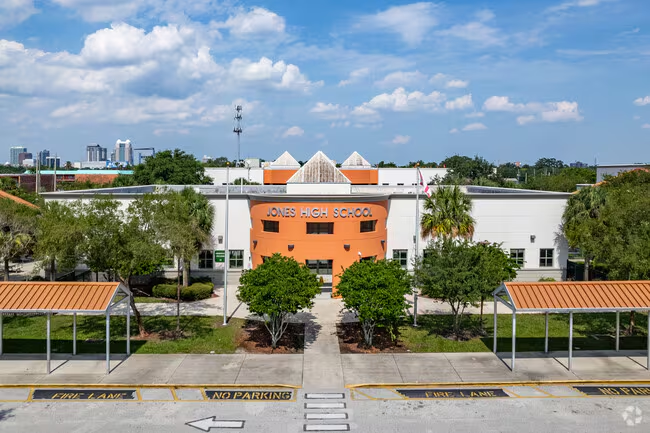
Jones High School Historical Museum
is located on the campus of
801 S. Rio Grande Avenue
Orlando, Florida 32805.
The Museum is currently open on Monday and Tuesday from 9:00am to 12:00pm during the regular school session.